

Spoken Word, Dance and Theater Merge in ‘Can’t, Don’t, Won’t Stop – Taking Spoken Word to the Next Level’
There ought to be a single word that describes the combination of spoken word, music, rhythm (think Stomp), dance, movement and acting. Labels like spoken word, poetry slam and performance art don’t begin to describe the theatrics in the show “Can’t, Don’t, Won’t Stop – Taking Spoken Word to the Next Level.”
“Can’t, Don’t, Won’t Stop” features Universes and Marc Bamuthi Joseph performing at the Rialto Center for the Arts in Atlanta this Friday and Saturday evening. Universes and Joseph, who have both performed in Russell Simmons’s “Def Poetry Jam,” will each showcase their slice-of-life performances culled from people of different cultures and backgrounds.
Universes, a four-member troupe from New York City that has won numerous theatrical awards, has toured overseas and in 25 cities around the U.S. Universes will perform “Live From the Edge,” a show that creates poetic language from childhood rhymes and community rituals. Creating the sounds of Bobby McFarin, a beat box, a gospel choir, African rhythms, hip-hop, jazz and the blues, Universes weaves through waves of emotions and life scenarios.
Seeing Universes is like seeing for the first time a theatrical performance by Blue Man Group, Pilobolus, Cirque de Soleil, or Sun Ra. It’s some of the best in performance art and like nothing you’ve seen before. read more…
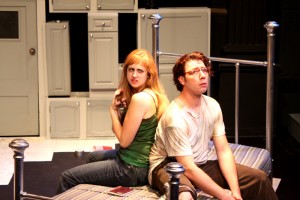
Eve Krueger and Topher Payne, Photo: Dominic Stanley
Hallelujah! Great, original, locally produced theater has arrived!
“Boom” is one of the smartest shows Atlanta has seen in some time. A fast-moving absurd, comedy that runs 90 minutes, “Boom” brings two unlikely dysfunctional characters together and asks: What would two people who intensely dislike each other do if they were the last human beings on earth?
A college journalism student, Jo (Eve Krueger), answers a Craig’s List ad for “intensely significant coupling.” She meets her date, Jules (Topher Payne), a marine biologist, in his university laboratory/home for a night of passion.
Within moments of meeting, Jo commands him to take off his clothes. But he’s not interested in sex. This gay man who has never had a sexual encounter with anyone has brought her here to save the world. He knows, from studying the swimming patterns of fish, that a meteor is going to strike the earth tonight and kill everyone on the planet.
When the meteor hits, everything on earth is destroyed but these two, who are safe in Jules’s hermetically sealed, vaulted home underground. They must remain inside the vaulted doors for at least two years to protect them from the hazardous environment outside. Jo, also a virgin, despises Jules and the thought of having a baby with him so much that she begs him to kill her.
This tale of how Jo and Jules repopulated the world is recreated inside a museum exhibit. Its docent, Barbara (Shelly McCook), shows viewers exactly what happened during that fatal epoch thousands of years ago.
While the premise may sound as ridiculous as that of Adam and Eve, the relationships between Jo and Jules are as real and twisted as those we see in real life. Credit is due to the truthful performances of all three actors, who make their characters believable and amusing.
Peter Sinn Nachtrieb, the author of “Boom,” has written numerous plays and won many play-writing awards. His play “Colorado” was performed at Dad’s Garage in Atlanta in 2007.
Directed by Joe Gfaller, “Boom” is playing at the Aurora Theatre in Lawrenceville, Ga., through Oct. 4.
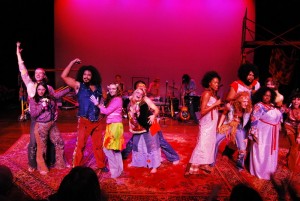
Hair at 7 Stages
If you saw the electrifying performance Bo Bice and the cast of “Hair” gave at the 2009 Tony Awards, you’ve probably been dying to see the show.
It’s now playing at 7 Stages in Atlanta. But it doesn’t come close to the Tony Award-winning version now on Broadway.
Nonetheless, if you can’t get there and want to celebrate love, peace, freedom and long-haired hippie life in New York City, this is your show. The cast will lure you in, talking, singing and dancing with you. And someone might even give you a lap dance.
Want something more provocative than that, like full-frontal nudity? You got it!
If you can go and focus on the message, rather than the messengers, you could end up having a swell time. You’ll have to overlook some things, like a blatant wig that contrasts drastically with a character’s skin tone, and a shag haircut that is a total anachronism. “Hair” takes place in 1967. The shag was invented in 1971 by Paul McGregor, who created it for Jane Fonda for the movie “Klute.”
While there are some good performers, a couple of them stand out.
Christie Lee Fisher is sweet as Crissy. She sings so prettily and with such emotion that I wanted to comfort her during one song as she was waiting for her man to appear.
Dionne (Dorothy Victoria Bell) is believable and truthful in all that she does on stage. She sings with such heart, soul and power that I could listen to her sing for hours.
The live band does a good job of uniting with the characters and bringing life to the production. Musicians include professionals from around the city who play in local bands and nightclubs.
Jonathan, a 20-year-old art school student who saw the show the same night I did, said, “Not much has changed in 40 years.”
He said he and his friends do the same things young people were doing in the ‘60s. They get high together on pot and mushrooms, they sing and dance to music, and they rail against the country’s involvement in wars overseas.
“Hair” runs at 7 Stages through Oct. 11.
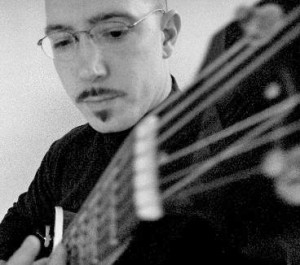
Dan Baraszu
Friday Jazz at the High Museum of Art in Midtown Atlanta will host a jazz quartet starring guitarist Dan Baraszu.
This evening, from 5 to 10 p.m., guests are invited to listen to the band and tour the museum.
The quartet will play mainstream jazz, funk and Latin tunes. Band members include Marlon Patton, drums; David Ellington, keyboards; and Joseph Patrick Moore, bass.
A guitar player for more than 25 years, Baraszu started out playing classical, rock, and blues. Upon hearing the music of guitarist Wes Montgomery, he devoted his studies to jazz. His music is also influenced by that of Bill Evans, Horace Silver, Sonny Rollins, and Charlie Parker.
Baraszu is a graduate of the Berkelee College of Music, where he majored in jazz composition and arranging. He later obtained a master’s degree in music from the University of Miami.
Ellington, a pianist and organist, also graduated from the Berkelee College of Music. He later studied with Ellis Marsalis at the University of New Orleans.
Starting at age 1, Patton began playing the drums. He graduated from the University of Georgia’s school of music with a bachelor’s degree in music performance. He plays with the Ken Watters Group and the Mace Hibbard Quartet. He also produces and records two other bands: Grogus, a Latin jazz band, and Heavy Mojo, a hip-hop group.
Baraszu teaches guitar privately and plays solo gigs Thursdays through Saturdays at the St. Regis Hotel in Buckhead. He also plays at private events and at jazz clubs around town.
He has recorded two albums: “Christmas Time is Here” and “Nightfall.”
From 5:30 to 10 p.m. the museum will also host a Single Mingle event, which will feature an ice-breaker game at 7:30.
Jazz at the High is free with museum admission, $18, and free to members. The Single Mingle event is $5 for members and $20 for nonmembers.

Top L to R: Stubblefield, Green. Bottom L to R: Freeman, Powell and Khan. Photos: Vincent Tseng
A gun sticks out from the top of the pants of a short, pale, bald man. He looks about age 35. He is standing on the corner of a secluded street in front of a blues bar I’ve never been to but am about to enter in Midtown West Atlanta. If he makes a quick move for that gun, or pumps one more rep at the gym, he just might burst out of that tight, yellow polo shirt he’s wearing.
As I walk closer I see emblazoned on the shirt a logo with the word “Police.” That makes me feel safer, and I exhale a sigh of relief as I walk inside a dark, cloudy club filled with people smoking, drinking and playing pool. I don’t go to bars, and my head begs me to go outside to escape the smoke that surrounds the room.
But Grant Green Jr., the son of one of my all-time favorite jazz guitarists–next to Charlie Christian–is playing inside. I have to hear him.
I sit on a stool at a tall table, next to a pool table with a few people in their 20s talking loudly and smacking balls around as the band plays. Within minutes a couple drinking beer decides to stand just feet in front of me, partially blocking my view.
On stage, Green is playing guitar while a cigarette dangles from his mouth. He is playing in a trio with a drummer and an organ player, like his daddy often did. But this trio is playing the blues. There is Vic Stafford on drums and headliner Ike Stubblefield on a Hammond B-3 organ, which looks like a big, wooden clunky piece of furniture from the 1930s.
I don’t listen to the blues much, but I like what I hear. The band’s got soul and rhythm, and I sway and groove to the music on my stool. It’s blues, blues-rock, blues-funk, and blues-jazz. The band plays one standard jazz tune where Green plays and sings just like George Benson. He swings on guitar.
Stubblefield is headlining, but I have never heard of him. I remember listening to Mike Bloomfield in the ’70s. I don’t remember listening to Ike Stubblefield. But I bet I did. Aside from working with Quincy Jones and Phil Spector, Stubblefield has played with some of the biggest names in the music business, including B.B. King, The Temptations, Stevie Wonder, and Rod Stewart.
For the band’s first set, the trio’s set includes some standards: B.B. King’s “The Thrill is Gone,” The Temptation’s “Just My Imagination” and the Spencer Davis Group’s “I’m a Man.” These three are solid–tight!–and the crowd is moving to the music.
It’s the second set, a jam session, that pulls dancers, drunk and sober alike, to the floor and makes the night.
First up: Sasha Swetlowski (harmonica), Justin Powell (bass) and Scott Freeman (slide guitar and vocals) wailing the blues.
Impressive on harmonica and still in his 20s, Swetlowski blares soulful sounds reminiscent of the Delta blues and blues-rock bands like J. Geils. Swetlowski is a member of an Atlanta blues-funk band, Soulhound, where he also plays keyboards.
Freeman, a former writer and editor for Atlanta Magazine and Creative Loafing, literally wrote the book on the blues. He has written books on the Allman Brothers and on Otis Redding, as well as two other books. He is working on a new book about his own life as a musician.
Since being laid off from his newspaper job, he, along with Powell, now plays full-time with his step-brother’s country-rock band, Bill Gentry & The 35 Cent Rodeo. Playing in bands since his high school days, Freeman wrings out as much emotion from the guitar he plays as he does from the stories he writes. He plays slide guitar and sings with the band, but what really knocked me off my feet was the passionate phrases he typed up and down the fret board while just warming up.
After Freeman, a young talented singer-songwriter, Zaib Khan, joins the band for a couple of tunes. Khan, who cites Elvis Presley as a big influence, has the king’s star good looks and plays guitar and sings in his own original style. Khan plays clubs regularly throughout metro Atlanta and North Georgia.
Green moved to Atlanta from New York City three years ago. I look forward to hearing him again in a jazz setting!

- Sarah Turner and Justin McGough as Edie and Joe Kennedy Jr.
No stranger to scandal and controversy, Jacqueline (Bouvier) Kennedy Onassis’s family is in the midst of it all in “Grey Gardens,” now playing at Atlanta’s Actor’s Express. But the connection to the Kennedys and the Bouviers is only part of what makes this a piquant, juicy musical. The story features sabotage, betrayal and divorce, while Edith Bouvier Beale spends improvidently, causing her and her co-dependent daughter to slide from high society to wretched squalor.
Socialites Edith Bouvier Beale—Jacqueline Kennedy Onassis’s aunt—and beautiful Edie live in an opulent 28-room mansion with servants in East Hampton on Long Island. Mr. Beale, a conservative, absentee, hypercritical father, resides in Manhattan and ultimately divorces Edith. George Gould Strong lives off the Beales at their home, known as Grey Gardens, where he plays piano and accompanies Edith, an amateur singer who performs at her house parties. At age 24, on the verge of obtaining her dream of leaving Grey Gardens and her eccentric mother, Edie prepares to wed Joe Kennedy Jr. But Edith has other plans. read more…
See my post from yesterday to see the review of his one-man show “MacHomer,” Miller’s interpretation of “Macbeth” as performed by Matt Groening’s “The Simpsons.”

Rick Miller
You may not have heard of, “MacHomer” or its creator, but you probably will one day. One of the greatest entertainers of our day, Rick Miller, performs his own twisted, truncated version of “Macbeth,” incorporating 50 characters of Matt Groening’s “The Simpsons,” as well as Sean Connery, O.J. Simpson, and well-known cartoon characters.
Although I couldn’t understand what the play was about, even with the synopsis in the program, I can tell you this: Rick Miller is the most talented, entertaining performer I’ve ever seen. When he becomes a character, it’s as if instantaneously its spirit jumps inside him and erupts from his face, body, and voice. While I’ve seen live performances from the best in my lifetime from the likes of Lily Tomlin, Whoopie Goldberg, Dick Van Dyke, to my all-time favorite, Sid Caesar, Rick Miller has bested them all.
Dressed in a kilt, long sleeve top, vest, waist purse, and army boots, he performs the script he wrote, based upon Shakespeare’s Macbeth and popular TV characters, mainly those from “The Simpsons.” A nearly bare stage features only a TV console from the ‘50s, which doubles as a cauldron, a prop he uses when he’s playing one of three witches.
“Macbeth” and “MacHomer” both begin with the appearance of three witches. In “Macbeth,” the characters Macbeth and Banquo have defeated two separate invading armies—one led by the rebel Macdonald, and they encounter the witches as they cross a moor. In “MacHomer,” MacHomer and Banquo run into the three witches, who declare that MacHomer will soon become king.
Instead of a Shakespeare “play-within-a-play,” “MacHomer” brings viewers a genius-within-a-genius: Miller doing Shakespeare. This younger genius, like Shakespeare before him, brings comedy and irony to his script. While embodying the physicality of nearly 80 characters during the entire show, Miller’s acting and singing are superb.
For an encore, Miller performs Queen’s “Bohemian Rhapsody” in the style of 25 characters, including Bob Dylan, Neil Young, Leonard Cohen, Barry White, Elvis Costello, Tom Waits, and Neil Diamond.
Miller has hosted ABC’s primetime series “Just for Laughs,” and has performed on stage in five languages on five continents. He is the creator of “MacHomer,” and co-creator of “Bigger Than Jesus,” “Hardsell,” and “Lipsynch,” all touring internationally. He also created and performed the solo shows “Art?” and “Slightly Bent,” which features 150 characters in 65 minutes.
Miller, who now lives in Toronto, holds a master’s degree in architecture. (He created the artwork of all the characters shown on the screen as he performs.) He studied acting and singing in college in his hometown of Montreal. He has performed in five separate Shakespeare productions and began working on “MacHomer” when he had a bit part in one of them. “MacHomer” continues each evening through Sunday at 7:30 p.m. at Georgia Shakespeare.
Click Here to See MacHomer Video
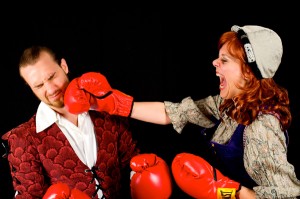
J.C. Long and Natasha Drena
A delightful production of “Kiss Me, Kate” has opened at the Aurora Theatre in Lawrenceville. It’s just a 45-minute drive from Atlanta, and worth it to see a great show in a beautiful theater.
Borrowing from Shakespeare’s play-within-a-play theme, “Kiss Me, Kate” revolves around two actors, Lilli (Natasha Drena) and Fred (J.C. Long), who once were married to each other, and are now starring together in the revival of Shakespeare’s “Taming of the Shrew.” Their relationship mirrors that of their characters, Kate and Petrucchio, who play the cat-and-mouse game of come close, go away.
When Lilli learns of Fred’s newest girlfriend, read more…

Gilda Sue Rosenstern
Oy, vey! Last night I saw “Gilda Sue Rosenstern” host a cabaret act at The Red Light Café.
The Southern hostess and character actress “Gilda Sue,” as she likes to be known on and off stage, trills words and sounds a lot like the waitress “Flo” from the ‘70s TV show “Alice.” She bills herself as “the gabbiest half-Jewish talk-show hostess on her never-ending quest for fame, cosmic truth, a handsome half-Jewish boyfriend, and a real, real rockin’ cocktail.”
After quite a bit of talking about her life as a half-Jew growing up in the South, she introduced her first guest of the evening, “Enzo,” (Vincent Tortorici) a Vaudevillian comic and trickster, who juggled cardboard bricks, tin plates, sticks, and his hat. (See my earlier post on him, June 11, 2009.) Even in the midst of his juggling act, Enzo kept one eye on the audience, and jibed the way of the wind. When attendees entered the club late in the midst of his act, to get them up to speed, he performed all his previous tricks again, in super fast motion.
Gilda Sue next presented folk-pop singer Nathan Beaver, a local singer-songwriter-guitarist, read more…