


Gilda Sue Rosenstern
Oy, vey! Last night I saw “Gilda Sue Rosenstern” host a cabaret act at The Red Light Café.
The Southern hostess and character actress “Gilda Sue,” as she likes to be known on and off stage, trills words and sounds a lot like the waitress “Flo” from the ‘70s TV show “Alice.” She bills herself as “the gabbiest half-Jewish talk-show hostess on her never-ending quest for fame, cosmic truth, a handsome half-Jewish boyfriend, and a real, real rockin’ cocktail.”
After quite a bit of talking about her life as a half-Jew growing up in the South, she introduced her first guest of the evening, “Enzo,” (Vincent Tortorici) a Vaudevillian comic and trickster, who juggled cardboard bricks, tin plates, sticks, and his hat. (See my earlier post on him, June 11, 2009.) Even in the midst of his juggling act, Enzo kept one eye on the audience, and jibed the way of the wind. When attendees entered the club late in the midst of his act, to get them up to speed, he performed all his previous tricks again, in super fast motion.
Gilda Sue next presented folk-pop singer Nathan Beaver, a local singer-songwriter-guitarist, read more…
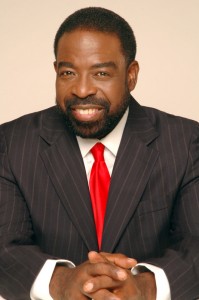
Les Brown
People didn’t expect much from the poor, “retarded” boy who flunked fifth and eight grades and never went to college. But motivational speaker Les Brown has since earned more than $55 million.
When Brown contacted the National Black Arts Festival about presenting a talk on the art of inspiration, program director Leatrice Ellzy told the audience all he asked for was a hotel room and airline tickets. The man we had seen give motivational talks on PBS for many years was once again a big-time philanthropist, just like he was when he “gave away” all those books and cassette tapes when callers donated money to the station.
Brown spoke at the Rich Auditorium at the Woodruff Arts Center Saturday, and introduced his family members in the audience: a sister, one daughter who was filming him, another who was there as his manager, a sister, and at least two other children. And, he said, he had two children who live here in Atlanta.
Brown’s messages are similar to other motivational speakers. Basically it is this: Work toward your goal, and put your best foot forward in all that you do to get the most out of life. He said if you have ever lost a job, you were supposed to move ahead in life. It was losing his job as a DJ in Ohio that spurred him on to become a public speaker, which, he said, has earned him $55 million. read more…

Lizz Wright, Simone, Joi Gilliam, Dianne Reeves
In last night’s National Black Arts Festival’s tribute to Nina Simone, four singers took the stage separately to remember one of the most recognized voices of jazz and soul.
Because Nina Simone’s voice was so unique (you know that voice within the first bar, if not the first two notes), it seemed to be with the highest regard to her that none of the singers—including her daughter—tried to emulate her sound. read more…

Robert Townsend
When a young black girl in Robert Townsend’s fifth grade class was called on to read “Oedipus Rex” aloud, probably no one outside of the west side of Chicago would have understood her abstruse Ebonics dialect. It was the 1960s, in a tough neighborhood in Chicago, and the only white person in the class was the teacher. When he called on Townsend to read Shakespeare, he was awestruck by this kid who sounded like he had been trained by the Royal Shakespeare Company. That’s because Townsend had trained with the Royal Shakespeare Company, sort of.
Townsend, who was interviewed by Spelman College history professor Jelani Cobb at the Woodruff Arts Center’s Rich Auditorium at the National Black Arts Festival last evening, said he wasn’t fond of reading Sophocles or Shakespeare, so he’d snatch albums from school and listen to the recordings of their plays performed by the Royal Shakespeare Company in London.
He had been doing impressions of movie and TV stars since he had been a tyke, and his impressions were near spot on. He loved portraying characters and would imitate their sounds and movements. Years later, he noticed he was mainly portraying white performers, because they played the major roles. Blacks in film were few and they only had bit parts, usually as the bad guy or the ignoramus. read more…

Gwen Hughes
While Atlanta’s jazz scene is not exactly thriving, there are pockets of the real thing, and vocalist Gwen Hughes is a big part of it.
On Saturday, Hughes performed at Actor’s Express with Mike Hinton, her fiancé, on drums and Bill Wilson, son of the late, great jazz pianist Teddy Wilson, on electric keyboards. As well as singing standards—a soulful rendition of “Bye, Bye Blackbird,” and a slow phrasing of the Gershwin brothers’ “Love is Here to Stay”—Hughes fused the set with blues, pop and show tunes. Her upbeat version of “Singing in the Rain” was a wonderful stray from the version Debbie Reynolds and Gene Kelly made famous, and was just as welcoming and upbeat.
Whether she’s mimicking a trombone player with her scat singing or belting out blues or pop, Hughes’s music pours out of her voice and body, sometimes in such contortions that she looks and sounds like a possessed Janis Joplin. But there’s no way to pigeonhole her style, as she clearly is influenced by a disparate group of rock, soul, gospel and jazz musicians. read more…
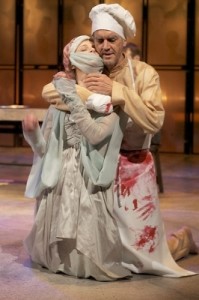
If there is anyone who has a reason for revenge, it is I, who would like to lop off the limbs of the man who recently stole nearly $130,000 from me and two others. Thankfully, having seen “Titus Andronicus,” I won’t, as clearly revenge is not so sweet. Perchance to dream rather than to act.
Now playing at Georgia Shakespeare, William Shakespeare’s “Titus Andronicus” matches the fear incited by the most gruesome horror movie, and it all happens in the name of revenge. A queen’s son is executed. A woman is raped, her hands are amputated, and her tongue is cut out. A queen’s illicit lover chops off a general’s hand and beheads his two sons. A chef serves a queen her own children up for dinner in mince meat pies. It’s so chilling, and at times so life-like, this production will make you cover your eyes and look.
Although the play was written around 1590, Director Richard Garner mixes many styles and the old with the new in this tragic tale of Roman life. Playing numerous instruments, including a home-built marimbula, Klimchak mixes time and place with compositions influenced by Gamelan, Latin, Arabic and African styles of music. The set (designed by Kat Conley) features Grecian architecture and modern sculptures. And costumes, selected by Christine Turbitt, consist of tunicas and shawls, as well as modern-day clothing: business suits, evening gowns and army wear. Perhaps the combination of different eras and countries is to remind us how closely the past resembles the present, especially as this century faces similar atrocities around the world in places like Sierra Leone, Iraq and Iran.
Georgia Shakespeare presents a good production of a wonderfully horrific play. Although initially unconvincing on opening night as Lavinia, Sarah M. Johnson became terrific after she suffered the atrocities thrust upon her. Tess Malis Kincaid portrayed Tamora with cunning power.
“Titus Andronicus” at Georgia Shakespeare runs through Aug. 2.
Amy Rush as Dewey Dell
If you’re troubled by the economy and dysfunctional relationships, see life as it was in the rural South in the 1920s.
In the backwoods in the hills, there’s a sordid affair with a preacher, a daughter who gets knocked-up as she is seduced for the first time, and a sane son who will be committed to a mental institution. Poor Addie Bundren, the matriarch dies at home and it takes the family days to transport her coffin 40 miles away to her hometown of Jefferson, in which she had requested to be buried. Her daughter Dewey Dell tags along, searching for a place where someone can help her abort her baby. And Addie’s toothless widow, Anse, comes on the burial trip just so he can buy a set of teeth and find a new wife.
Amy Rush, who plays daughter Dewey Dell, is a stand-out as is the live and recorded music. As she is seduced, we hear a recording of a crooner from the 1920s, “You’re the kind of girl that men forget, just a toy to enjoy.” Whether she’s performing as a marionette, a person or a shadow puppet, Rush is full or passion and compassion. Musician Damon Young gives the production a light, carnival feel as he throws plastic eggs at some of the shallow characters of little substance. Originally performed in 2007, the script has been tightened so much that the show is only 1 hour and 15 minutes.
Haverty Marionettes’ version of William Faulkner’s “As I Lay Dying” plays at the Hertz Theatre at Woodruff Arts Center through this weekend.For ticket info, visit Hertz Theatre.
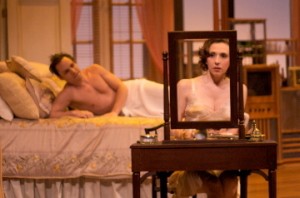
Daniel Thomas May and Courtney Patterson
Tennessee Williams’ “Cat on a Hot Tin Roof” is a wave of heat. Scorching summer temperatures, seduction, “mendacity,” and fights between in-laws for Big Daddy’s inheritance of his 28,000-acre Mississippi plantation and estate home cause many a burn. But the production at Georgia Shakespeare is a little cool.
It’s the late 1950s, and Maggie and her husband, Brick (Daniel Thomas May), are visiting his parents’ home, sleeping in their luxurious guest bedroom, which has no air conditioning. Maggie, a searing siren with a burning sex drive for her gorgeous husband, tries to seduce him so she can have a baby, prompting Big Daddy to leave them lots of money when he dies. Brick—who likely is homosexual—can’t stand the sight or sound of her, and hasn’t slept with her for some unnamed time since his “best friend” Skipper died. Maggie had an affair read more…
Thirty one years later, and Libby Whittemore is still as good as the last time I saw her in 1978 at The Harlequin Dinner Theater.
Playing at Actor’s Express through Sunday, Whittemore shares the stage with her longtime singing partner, Lisa Paige, and her musical arranger, Robert Strickland.
For their first set Friday evening, backed by a trio—upright bass, piano and drums—the singers performed hits from the ’60s and ’70s, “Happy Days-Get Happy,” the Judy Garland and Barbra Streisand duet, as well as tunes by the Pointer Sisters, Bette Midler, Carole King, and Nancy Sinatra.
For the second set, Whittemore performed read more…
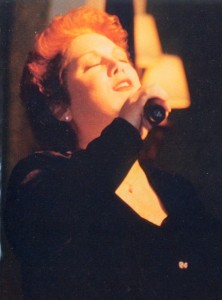 Libby Whittemore, who will be performing at Actor’s Express today through Sunday, has been performing in cabaret clubs and in musical shows since the 1970s. I first saw her perform as Sally Bowles in “Cabaret” in 1974 at Northside High School (now North Atlanta High School). Whatever magic Liza Minnelli had as Sally, Whittemore had it too. The show made her a star around the city.
Just after graduating that year, Whittemore began performing in musical theater professionally around town. When she got an invitation to perform in Los Angeles in the ’80s, she moved there for a while, hoping to find bigger jobs, bigger paychecks and, of course, fame. But her showbiz career dwindled there, so she moved back to Atlanta where she could always sing in cabaret clubs. read more…