

Cast of ‘Phantom of the Opera’
to Perform Broadway Hits at Balzer Theater
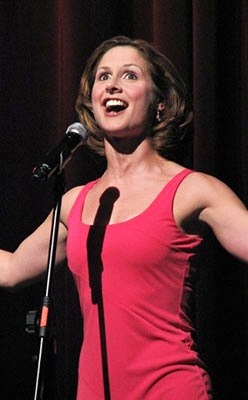
Kelly Grant
Some cast members of the Broadway touring company of “Phantom of the Opera” will perform a one-night-only cabaret of standard musical theater songs, as well as some new and rarely heard tunes, this Monday at Theatrical Outfit’s Balzer Theater at Herren’s.
Cast members have performed on Broadway and in national touring companies and have sung with pop stars and opera companies around the world. They have also sung at the Spoleto, Aspen and Eastern Music festivals.
The associate conductor for the National Tour of “Phantom” and former conductor for the National Tour of “Evita,” David Robison, will serve as musical director and pianist.
Songs will include “Can’t Help Lovin’ Dat Man,” “All That Jazz,” “Dirty Old Man,” “Sit Down You’re Rockin’ the Boat,” “Send in the Clowns,” a “Merry Poppins” medley, and other tunes by the most popular Broadway composers. No songs from “Phantom of the Opera” will be performed, and some songs may include strong language or address adult themes.
Phantom cast members expected to perform include Dara Adler, D.C. Anderson, Kelly Jeanne Grant, Luke Grooms, Michael Scott Harris, Satomi Hofmann, Juliette Javaheri, Anne Kanengeiser, Silvio Scambone, Pamela Shandrow, Kim Stengel and Elizabeth Welch.
The production is a benefit for Synchronicity Threatre’s Playmaking for Girls, a community outreach and mentor program for underserved tweens and teens.
Broadway Sings for Synchronicity will be held Monday, July 12 at 8 p.m. at Theatrical Outfit’s Balzer Theater at Herren’s in downtown Atlanta. Tickets are available at Synchronicity Theatre.
“Phantom of the Opera” plays through July 18 at the Fox Theatre.
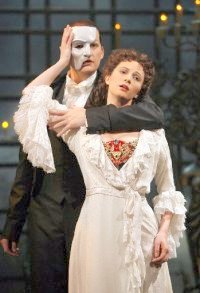 If “Phantom of the Opera” is not the greatest musical ever, there must be some other reason it is the longest running Broadway show in history.
Now at the Fox Theatre, Andrew Lloyd Webber’s musical is an eerie love story based on the 1911 novel by Gaston Leroux about a chorus girl, Christine Daaé (Trista Moldovan), and a haunting ghost, the Phantom (Tim Martin Gleason).
The Phantom has been haunting the opera house for years. When new managers take over, he demands that they replace the star of the opera with Christine.
A former musical genius with a disfigured face, the Phantom lures Christine to him and takes her on a gondola ride on a lake to his lair. When he returns her to the opera house to perform, she vacillates between her love for him and her new love interest and childhood friend, Raoul (Sean MacLaughlin).
The play can be difficult to follow at times. Words are not always discernible. But it’s well worth the struggle to try to pay attention to the lines and what is going on above the set. Sometimes, the Phantom’s voice seems to come from somewhere far off, and since there is no spotlight pointing him out, you need to look closely to find him on the roof of the opera house.
Although the lyrics are sometimes incomprehensible, especially when two or more people are singing different words, the music is beautiful. Webber weaves pumping percussions, rock and opera to create unforgettable tunes, such as the lullaby “Think of Me,” and Billboard chart-toppers “Phantom of the Opera” and “All I Ask of You.” The original London cast recording is the highest selling cast album in history.
The design is by the show’s original designer, Marie Björnson, who won “Phantom” two Tony Awards: one for Best Scenic Design and one for Best Costume Design. Backdrops portray exotic locations like India, a life-size elephant appears on stage, and a jet-size lighted chandelier floats to the rafters of the opera house and later plummets to the floor. Colorful gowns with swaths of blue, green, red and gold brocade drape opera characters and recall the dress of earlier centuries in France and Spain.
On the cast album and in other productions Christine is the standout, but in this production it is Gleason, who performs in a tux with black coattails and a white mask that covers half of his face. While other characters are sometimes difficult to understand, his annunciation is perfect and his singing voice is outstanding. He moves like a dancer displaying his love for Christine, and he is a charming suitor who tugs at the heartstrings. But when she snatches the mask off him, he instantaneously metamorphosis into a creature that resembles Dracula.
“Phantom of the Opera, opened in London in 1986. After it opened on Broadway in 1988, it won seven Tony Awards, including one for Best Musical. The show is still running in both locations. The show is still running in both locations.
The touring company production is directed by the show’s original Broadway director, Harold Prince, who himself has won 21 Tony Awards. “Phantom of the Opera” is completing its sixth and final Southeastern trip for Webber’s touring company, The Really Useful Company, according to the playbill.
Music by Andrew Lloyd Webber; lyrics by Charles Hart; additional lyrics by Richard Stilgoe.
“Phantom of the Opera” runs through July 18 at the Fox Theatre.
If you have seen “Kiss Me Kate,” you may wonder why you should see Georgia Shakespeare’s “Shrew: The Musical.”
Don’t wonder. Just see it.
I know you’re thinking, “What could best the Tony Award-winning production by Cole Porter?”
Quite possibly the script and lyrics of John R. Briggs and original music arrangements of Dennis West.
Sure, both shows are similar takeoffs of “Taming of the Shrew.” But Briggs, who says he has never seen “Kiss Me Kate,” writes in the program notes that his version is different because it takes place in Miami and is a musical adaption of Shakespeare’s play within a play, unlike Porter’s production, which is about a theater troupe performing “Taming of the Shrew” and the action that takes place behind the scenes.
“Shrew: The Musical” basically sticks to Shakespeare’s story. Bianca (Ann Marie Gideon), has just become of age to wed. But her wealthy father, Baptista (Allen O’Reilly), declares that no one may wed her until her older, raucous sister Kate (Park Krausen) is first married.
While suitors vie for Bianca’s attention, no one courts Kate. That is until Petruchio (Joe Knezevich) comes to town to find a woman whose hand in marriage will bring him a fortune. No matter that the two quarrel incessantly and she wants nothing to do with him, the two wed.
“Shrew: The Musical” employs modern language that is simple to understand. The show recalls life and characters from decades gone by and musicals like “No, No, Nanette” and “Guys and Dolls.” Damon Runyon-type characters with New York and Cuban dialects dress in Sinatra-style fedoras and Gatsy-era fashions, and bring back Vaudeville and the jazz era with brief imitations of Durante, Groucho and Sinatra.
Briggs says he and West wrote the music as an homage to the Gershwins, Duke Ellington, Johnny Mercer and Fats Waller. One tune has a swinging Stray Cats flair to it, and one is a celebratory gospel number. The music and script are tight and full of life.
While the singing and acting are good, the dancing falls short. The performers know the steps but lack the energy that should encompass them. The music is fiery and Jen MacQueen’s choreography is fine. If the dancers would spit fire when they danced, this show would be more than smoking. It would be a blaze.
“Shrew: The Musical” runs in rep with “Love’s Labour’s Lost” and “King Lear” at Georgia Shakespeare through August 6.
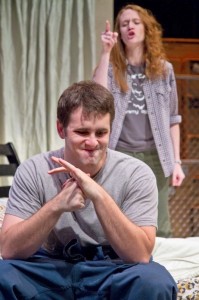
Jacob York and Rachel Richards
If future productions are as good as its first show, Pinch n’ Ouch Theatre is on its way to success.
Now playing at the Hertz Theatre at Woodruff Arts Center, “Reasons to be Pretty” follows two couples in their early 20s grappling with relationships with their significant others. Written by Neil LaBute and nominated for a Tony Award for Best Play 2009, the play slices into ugly, raw veins of young adulthood making characters bleed.
“Reasons to be Pretty” opens with Steph (Rachel Richards) brandishing a curling iron, daring Greg (Jacob York), her boyfriend of four years, to tell her what her best friend Carly (Bree Dawn Shannon) overheard him say about the looks of her “regular” face. While he squirms and cowers in a chair, Steph stomps on his boots, hurls curse words at him and forbids him to leave the room, even though he is running late for work.
Carly, a pretty blonde, and her husband, Kent (Grant McGowen), work at a packing plant with Greg. The newlyweds seem to be happily in love, but their relationship fizzles when Kent latches on to a new “good lookin,” “sexy-dirty” coworker.
These troubled young adults attempt to claw themselves out of failed relationships, bad friendships and blue-collar jobs. Greg, who seems to be the weakest, is the only one who manages to do all three. When he has had enough of Kent’s lies and bullying, he knocks him to the ground with a few punches and leaves him lying there with a bloody nose.
The play presents plenty of drama and sad, comedic situations where characters act half their ages. Even when some scenes are a bit unbelievable, Richards plays true to her character, arguing relentlessly with Greg, yet pining for him when he is not around. Shannon’s joy and pain are written on her face, and that is all she needs.
The co-founders of Pinch n’ Ouch Theatre, Shannon and McGowen, both in their 20s, worked in theater in Atlanta and studied the Meisner acting technique together in New York. Sanford Meisner told actors not to react to any circumstance until they felt a stimulus. He used the example of a pinch and an ouch. The actor must first feel the pinch (or stimulus) before he can respond with an ouch. Hence the company name.
This fall, Pinch n’ Ouch will present the Atlanta premiere of “Lobby Hero” by celebrated playwright Kenneth Lonergan, whose films “Gangs of New York” and “You Can Count on Me” were nominated for Academy Awards.
“Reasons to be Pretty” runs through June 27 at the Hertz Theatre. Visit Pinchn’Ouch.
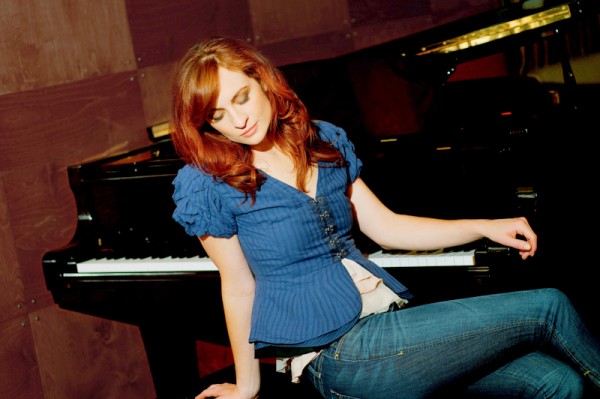
Jess Godwin
Jess Godwin may not be known as a singing sensation now, but just you wait.
She’s been playing music circuits in New York, Chicago and Atlanta the past year and has been playing piano and singing since she was a tyke.
To celebrate the release of her new CD “Quiet the Room,” she will play gigs in all three cities this month.
Godwin recorded the CD under the watchful eye of Jan Smith, the Atlanta vocal coach and consultant to numerous stars, including Usher, Keyshia Cole and American Idol runner-up Diana DeGarmo.
Godwin pens her own lyrics and music, which is peppered with flavors of R&B, pop and rock-style show tunes.
A classically trained singer and pianist, Godwin writes with a poetic and humorous flair. In “Too Late For Love,” she chirps like a bird: “I try to be coy, I try to be calm and collected, I come off neurotic . . . I beg you to deprecate me.”
Her catchy tunes and lyrics are memorable and contain scenarios that many of us have pondered. “Three Weeks Shy” asks, “Did you forget my number, Did you run out of minutes? Did I come off as boring? Was it something I said? If I had worn the blue dress, if I ordered the burger, would you have called me?”
Although the red-headed vixen has been compared to Regina Spektor, Alicia Keys and Norah Jones, Godwin has a sound all her own. Whether she is belting out a tune or singing in falsetto where her high notes soar like a smooth slow wave at sea, she comes across like a star.
Godwin studied classical music at Vanderbilt University and obtained a degree in theater from Columbia College Chicago.
Upon graduation, Godwin worked in numerous theaters around the Windy City, including Steppenwolf, the launching pad for Laurie Metcalf, John Malkovich and Gary Sinise. Godwin’s agent got her auditions in New York where she won a role in Rodgers’ and Hammerstein’s show “Carousel” in one of the country’s premier theaters, the Long Wharf in New Haven, Conn. While performing there, she realized that she needed to go back to her true love: playing and performing her original tunes.
Her first CD, titled “Jess Godwin,” is a three-song sampler of her music. “Quiet the Room” contains four songs and was created in hopes of attracting a recording contract.
Godwin plays Morseland in Chicago June 13, Smith’s Olde Bar in Atlanta June 15 and The Bitter End in New York July 16. For more information on upcoming gigs and to listen to her music, visit jessgodwin.com.
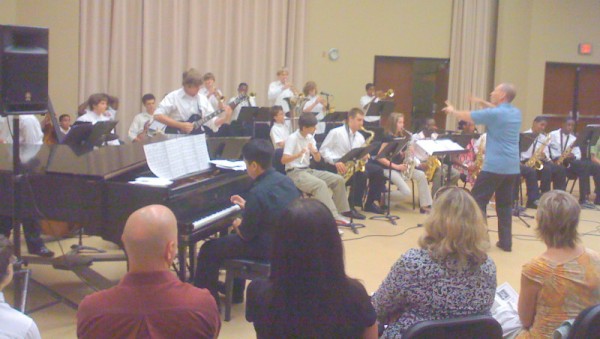
JOA's Summer Jazz Camp 2009
While Jazz Orchestra Atlanta’s summer jazz camp won’t make up for those schools across metro Atlanta that are cutting band and orchestra programs, it will give students the opportunity to play with professional jazz musicians and study music in a college setting.
Students rising in grades eight through 12 will be able to study and play jazz at camp held at Georgia State University June 21-25 from 9:30 a.m. to 3 p.m.
Sponsored by Jazz Orchestra Atlanta, a nonprofit that supports music education and jazz performances, camp will offer classes in jazz theory, improvisation and the music business and will provide information on college jazz programs around the country.
“We will offer students a jazz experience they don’t get in their schools,” said Brent Runnels, executive and artistic director of JOA. “In a relaxed and supportive environment, students will practice, rehearse, read music and perform alongside some of the best professional musicians in Atlanta.”
Instructors will include Runnels, an award-winning classical and jazz pianist; the coordinator of jazz studies at GSU, Gordon Vernick, who has played with Randy Brecker and Paul McCandless; drummer Justin Varnes, who has toured with Phoebe Snow and recorded with several jazz greats in New York; GSU saxophone instructor Mace Hibbard, who has performed with Marcus Roberts and Susan Tedeschi, as well as on The Derek Trucks Grammy Award-winning album, “Already Free;” and GSU instructor and bassist Robert Dickson, who has performed with Dizzy Gillespie and Terri Lynne Carrington.
Although Forrest Cobb had played flute in the Westminster Jazz band for three years, he didn’t know how to improvise on the first day of jazz camp last year.
But by the end of the week that changed.
Cobb said, “I had figured out what notes were in a chord and how to improvise using them. I realized there is a structure underneath what is written, and now I can interpret that.”
Cobb says he also learned about creating “color” and “dissonance” in the music, and how to “resolve” the end of a tune so it sounds smooth, yet still interesting.
“We’re going to address all styles of jazz and take students as they are with their interests and move them forward in those areas,” said Runnels. “We’re taking early intermediate to advanced-level musicians and providing them with structure, inspiration, motivation, technical training and a chance to play in front of a crowd.”
On Thursday evening, June 24, students will jam at a yet undisclosed downtown restaurant and will present a big band concert Friday, June 25 at 2 p.m. at the GSU Aderhold Learning Center.
Now in its eighth year, JOA is still accepting students for its summer jazz camp. For more information, visit Jazz Orchestra Atlanta.
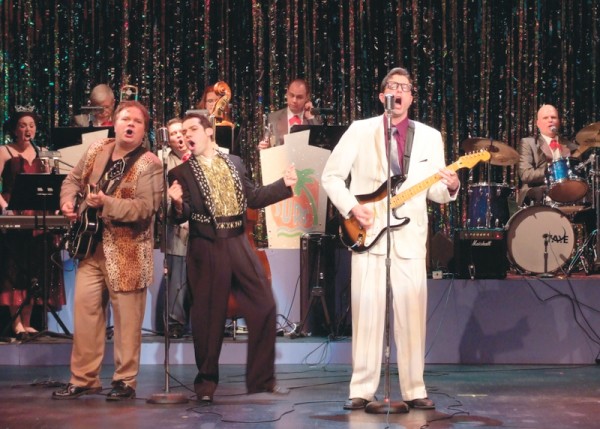
Dolph Amick, Ricardo Aponte, Rob Lawhon. Photo: Bill DeLoach
At least half a dozen of them, the Red Hat Ladies, spring out of their seats in their screaming purple dresses and flying saucer-sized red hats, stomping and clapping to Buddy Holly singing “Johnny B. Goode.” When the bespectacled singer shifts into the finale, “Oh, Boy!” nearly the entire audience rises to its feet dancing and clapping.
Georgia Ensemble Theatre’s production of “Buddy: The Buddy Holly Story” ends with a bang, but it sputters along the way.
After a live performance of Buddy Holly & the Crickets is broadcast on radio station KDAV in the band’s hometown of Lubbock, Texas, in 1956, Buddy Holly (Rob Lawhon) receives a recording contract with Decca Records in Nashville. During the recording session there, the record producer tries to twist Holly’s pumping rockabilly sound into languid country tunes. Holly chucks the contract and travels with the band to a studio in New Mexico where he records his music his way.
The record goes gold. The band travels around the country and becomes the first white band to play Harlem’s Apollo Theatre. Holly leaves the band, moves to New York, falls in love at first sight, marries and plays gigs around the country.
That about sums up the entire show. If it sounds light on plot, it is.
Unlike the movie, which pulls you into Holly’s life and gnaws at your emotions, the play, as performed by GET, does neither. More than a story, this is a showcase of about 20 Buddy Holly tunes. There are moments when Lawhon is a believable Holly. But too often, he and most of the cast overact and talk at, rather than to, one another.
One exception is actor Tim Batten, who plays New Mexico record producer Norman Petty and a backup singer at Holly’s final gig in Clear Lake, Iowa. Batten consistently performs truthfully as if the scenes and his characters are real.
But a sense of reality, in general, is missing from the show. Instead of relying on a strong script and credible acting to engage the audience, this production relies on shtick as side performers run among the audience pulling granny-aged women out of their seats to dance.
In addition to the three-piece Buddy Holly & the Crickets band, the show features other musicians who perform throughout the show.
One of the best musical scenes is Holly’s final concert, which features separate acts: J.P. “The Big Bopper” Richardson (Dolph Amick) and Richie Valens (Ricardo Aponte).
In “Chantilly Lace,” Amick incarnates The Big Bopper while talking to his sweetie on the phone. In typical Bopper fashion, Amick opens his eyes wide, smiles slyly and trills his words (a la the talking horse Mr. Ed), “You know-oh-oh-oh-oh-oh what I like.”
The theatrical musical and dance standout is Valens, who darts about the stage as the band plays “La Bamba.” Wearing tight black straight legs, a black shirt with a wide band of gold down the front and a matching bolero, Valens bounces around the stage, swinging his hips salsa style, banging on the bongos as he sings. His passion brings life and electricity to this show.
If there are any flaws in this production, the Red Hat Ladies don’t seem to notice. Apparently, neither do a lot of people. This is the second consecutive year GET has staged this production.
Now in its 20th year, “Buddy: The Buddy Holly Story” is “the world’s most successful rock and roll musical” and has been “viewed by more than 20 million people,” according to the official Buddy Holly Story website. There, the synopsis talks about scenes that are not shown in the GET production. If those scenes had been shown, perhaps the story would have had more substance.
“Buddy: The Buddy Holly Story” runs through June 6 at the 14th Street Playhouse.
Q . . .
Cyou tuh.
“Avenue Q” is cute.
When recent college graduate Princeton arrives in New York City with an English degree, he has dreams of making it big. But just before he is to start his new job, he gets a call that his position has been eliminated due to recent downsizing. Mourning his fate, he breaks out into song with “It Sucks to Be Me.”
But it doesn’t suck just to be him. Apparently, it sucks to be everyone else in one apartment building on Alphabet City’s Avenue Q, as dwellers all join in one-upping the other on why it sucks even more to be them.
Modeled after “Sesame Street,” most of the characters down on Avenue Q are nearly life-size puppets handled by actors who appear onstage with them. The actors move their bodies in unison with the puppets, most of whom have only upper torsos.
As well as puppets, there are a couple of people: Bruce, a fat, white, frizzy-haired unemployed, sloppily dressed Jewish comic, a clear takeoff on Bruce Vilanch; Christmas Eve, a Japanese psychotherapist who has only one client; and Gary Coleman, the black has-been actor of “Diff’rent Strokes” who is the superintendent of the apartment where most of the characters reside. This mixture of the show’s characters and ultra-liberal puppets provide the perfect setup for the song “Everyone’s a Little Bit Racist.”
Other characters include Rod, a closeted gay Republican banker puppet and his roommate Nicky; devilish bears who persuade Kate Monster and her love interest, Princeton, to get drunk and have sex; Lucy, the sultry, loose chanteuse interloper who seduces Princeton; and Trekkie Monster, who says the Internet is for porn. Well, come to find out, to Kate Monster’s amazement, most everyone in the neighborhood loves Internet porn too.
Interspersed throughout the scenes, a screen drops down with numbers, letters and words with short lessons similar to those shown on “Sesame Street.” Except these are adult lessons, like how to spell the word “commitment.”
There is some profanity in the show and a scene in which puppets Rod and Kate have wild, passionate sex, so this is not a kid-friendly puppet show. But on Tuesday at the opening at Cobb Energy Performing Arts Center near Atlanta, there were more young people in their 20s than I normally see at the theater. If this type of humor is the catalyst that brings young adults to the theater, this city needs more of it.
“Avenue Q” won three 2004 Tony Awards for Best Musical, Best Book of a Musical and Best Original Score, beating out close contender “Wicked” for all three. “Avenue Q” is a cute, funny, smart show, but on opening night there was a problem, which not only I and my companion experienced, but also the people around us, as we overheard quite a few people during intermission say they could not understand all the words the characters spoke. More so than a sound problem, it seemed to be an annunciation problem.
“Avenue Q” has played around the world, including Hungary, Turkey, Brazil, Italy, Israel, Australia and England.
The national touring company of “Avenue Q” performs through Sunday, May 23 at Cobb Energy Performing Arts Center in Atlanta.
Bad Boys of Dance soars with the swagger of Michael Jackson, the finesse of Gene Kelly, the grace of Baryshnikov, the confidence of Patrick Swayze, and the chops of Gregory Hines.
Chosen for their good looks, young taut bodies, and bad-boy attitudes, these umm, umm male hotties are known as some of the top dancers in the nation, says the dance company’s artistic director and founder, Rasta Thomas.
Thomas, 28, is a prodigy who has performed in commercials, at the Academy Awards and with the finest ballet and dance companies throughout the world, including Twyla Tharp, the Joffrey Ballet and the Kirov Ballet in St. Petersburg, Russia. He created Bad Boys of Dance to showcase the beauty and excitement of an all-male dance troupe.
“Ballet is boring,” Thomas says, “and even the people doing it often don’t like it.”
Trained in ballet, martial arts and all forms of dance, Thomas has been performing with professional companies since he was 13. Tired of the traditional dance world, Thomas decided to create a dance troupe with the allure of a bad-boy rock band like Aerosmith. Luckily, his dancers look more like the sexy male equivalent of Liv Tyler than her rocker dad Steven Tyler.
Thomas’s sultry dancers fuse gymnastics with martial arts, ballet, jazz, hip-hop, Broadway and ballroom to attract audiences of all ages from tweens to senior citizens. Thomas’s wife, Adrienne Canterna, serves as resident choreographer for the troupe and sometimes dances with them. In the two years since the company began, Bad Boys of Dance has performed consistently throughout the U.S. and Europe.
Bad Boys of Dance performs at the Ferst Center for the Arts Thursday, April 22 at 8 p.m.
Called “one of the most thrilling acts on the planet” by LA Weekly, Fishtank Ensemble has traveled the west coast since 2005 playing “gypsy music,” a cross of Romanian folk, jazz, Flamenco, and music with Balkan, Turkish and Tango influences. The quartet features a Mexican guitarist, a French violinist, a Serbian slap bass player and an American vocalist, Ursula Knudson, who also plays banjo, ukulele and a musical saw.
Yes, lots of gypsy sounds, but Knudson’s operatic singing on upbeat jazz tunes is like listening to a mixture of Annie Lambert and Betty Boop.
The Daily Page, in Madison, Wis., said the band’s performance was “one of the best shows of the year.” It described it as “ Fusion gypsy music, played with unbelievable virtuosity on odd acoustic instrumentation and the energy of punk and rockabilly.”
Fishtank Ensemble plays Eyedrum this Thursday at 8 p.m.