


L to R: Anthony Rodriguez, Ingrid Cole, Jeremy Wood & Laura Floyd, Photo: James M. Helms
The Broadway musical “A Catered Affair,” book by two-time Tony Award-winner Harvey Fierstein with music and lyrics by John Bucchino hits the Aurora Theatre in Lawrenceville this week. The Broadway show, starring Harvey Fierstein, ran on Broadway in 2008. The musical was nominated for three Tony awards and 12 Drama Desk awards.
Aurora is giving away two tickets for any performance to each of the first three people who leave a comment on this blog.
I spoke with John Bucchino last week via telephone.
Can you give us a one or two sentence what “A Catered Affair” is about?
It’s about communication within a family and being honest with one another and with yourself.
What do you personally relate to?
I relate to the young people in the show and what they go thorough between trying to please their parents and being who their parents want them to be. They struggle with asserting their individuality, being who they truly are and deciding what they want for themselves. We all go through that.
How did you go about composing for this?
Harvey wrote a straight play without any songs. Then he emailed me a copy of it and said let’s each read this and think of where we think individual songs should happen. We each made our own list of where we thought songs should go and then compared our lists. They were almost identical.
Which song gave you the most difficulty when you were writing it?
“Immediate Family” is one of Harvey’s (Harvey played Uncle Winston) big up-tempo numbers. It’s funny but also angry. It’s always hardest to write a funny song. I know there are writers who love writing big funny numbers but hate writing emotional ballads. I’m the opposite. On the other hand the easiest song to write was “Coney Island,” another song Harvey (Uncle Winston) sings. Writing that was a remarkable experience for me. One morning—I think it was three-thirty or four in the morning—I bolted up in bed, heard it in my head and sang it straight through into a memo recorder. The whole melody just popped into my head fully formed. That’s never happened before to me. I was working on it in my sleep, I think. It just poured out of me. The song has remained exactly the same. The next morning I wrote the lyrics.
What’s your favorite song in the show?
I love a song called “Vision” where the mother is envisioning her daughter’s wedding, the wedding she herself never had. It’s poignant. I love the way the music and chords build in that song.
Which do you compose first, the music or the lyrics?
I almost never write the music first. I usually write at least part of the lyrics first because the lyrics create the framework. The lyrics are the hard part, so I force myself to deal with that part I don’t like so much and then let myself deal with the part I really like, which is the music.
How did this collaboration come about?
Harvey heard my first CD, “Grateful” with me on piano accompanying some illustrious singers: Liza Minnelli, Judy Collins, Art Garfunkel, Patti LuPone. He wrote me a wonderfully complimentary letter saying he loved the CD. A month later he wrote me again saying he was playing it over and over again and asked if I wanted to have dinner. We had dinner and he asked if I wanted to collaborate on this with him. Initially I said no. I asked my best friend, Steven Schwartz, who wrote music for “Wicked,” “Pippin,” and lots of other musicals what he thought. He said he thought I’d be suited to do it perfectly. So I eventually said yes.
How did the show end up at Aurora?
Ann-Carol Pence (Aurora’s musical director) saw the show on Broadway and I guess fell in love with it. She said the first time the cast went through it there were lots of tears, which is always good. My primary concern is that any piece of my writing elicits an emotional response. I want my work to resonate and touch them.
How did you first start in music?
I started playing piano when I was about a year old. Not banging on it, actually playing delicate melodies, making up songs. I taught myself how to play. I still play only by ear. I know what notes are. I play things into a computer and have someone transcribe it.
What would you be doing if you weren’t earning money as a musician?
I spent some time in Africa a few years ago working with orphans who have AIDS. I worked with them and started a music program. I taught them Beatles songs and learned their songs. I haven’t really made a living just from my writing yet. Lately I’ve been doing master classes with college kids where they learn my songs, and I coach them on performance of my music. I like working with young people in music. Their energy and enthusiasm reminds me of when I was young and optimistic.
What’s your favorite thing about “A Catered Affair”?
My favorite thing is that the show really moves people. I saw people in the audience in New York who when the show was over they just sat there and didn’t leave the theater for many minutes because they were so emotionally affected by it.
Why should people go see the show?
The show will transport them to a time and place that will be relevant to their lives, even though they may not have been around in the 1950s. The show will make them think and reevaluate some aspects of their lives and make them feel very deeply.
Bucchino will attend the opening night at Aurora Theatre March 4 at 8 p.m. The show runs through March 28.
Masters of Persian Music will be improvising and playing classical Iranian music at the Ferst Center for the Arts at Georgia Tech this Friday. World music somewhat reminiscent of Ravi Shankar, Masters of Persian Music includes three generations of performers.
Hossein Alizadeh (shourangiz and tar) has played with the National Orchestra of Iran and was conductor and soloist of the Iranian National Radio and Television Orchestra. He has taught at the University of Tehran, the Tehran Music Conservatory and the California Institute of the Arts.
Kayhan Kalhor (5-stringed kamancheh) is a three-time Grammy Nominee and has written scores for film and TV, including for Francis Ford Copolla’s “Youth Without Youth.”
The band’s tour includes major cities across the country, including New York, Chicago and Washington, D.C. MPM’s album “Faryad” was nominated for a Grammy Award.
Show time is Friday at 8 p.m. at Ferst Center for the Arts.
Saturday at 8 p.m. at Ferst Center for the Arts it’s Kenny Barron, Kurt Elling and Regina Carter!

L to R: Nevaina Rhode, Terry Burrell, Carolyn Cook, Mary Kathryn Kaye, and Courtney Patterson Photo: Chris Bartelski
Leave it to comedic Atlanta playwright Janece Shaffer to make a comedy out of racism.
In her play “Managing Maxine,” performed last year at the Alliance Theatre, she made us laugh at love between two senior citizens. Now she trumps that with the complexities and humor of racism in the South.
Directing her latest play “Brownie Points,” now playing at Theatrical Outfit, is renowned entertainer Jasmine Guy, who recently directed “For Colored Girls Who Have Considered Suicide When the Rainbow is Enuf.”
Both Guy and Shaffer probably have their own experiences with discrimination in the South. They grew up in the 70s in Atlanta when there were a lot fewer Jews–Shaffer is Jewish– and a lot fewer mixed marriages–Guy’s mother is white and her father is black.
Set in the present an hour outside of Atlanta, ”Brownie Points” looks at prejudices and racism as five women take their daughters’ Brownie troop on a weekend camping trip. The kids get along fine, but the women have trouble playing nicely.
Allison (Carolyn Cook) has planned the weekend precisely in 15-minute increments. With Deidre (Terry Burrell) arriving more than two hours late to their cabin, Allison begins to boil. And when Deidre realizes Allison has scheduled her and Nicole for kitchen duty all weekend, she becomes outraged that a white woman would schedule the two black mothers for kitchen work as if they are some type of “Aunt Jemima.” Topping Deidre’s anger even more is that Allison chose Forsyth County, Ga., a county known for its racism, for their camping site.
Although it revolves around racism, the play doesn’t feel preachy at all. Shaffer has peppered the script with humor from the lines people say—“I graduated tops in my class if you don’t count the Asians and Indians”—to the ironic situations.
There is no resolution that finally shows one mother is prejudiced or one is not. Shaffer and Guy have created a production that makes us conscious of how people of other races and religions might perceive our actions, whether they be locking a car door when we see a black man or assigning two black people to kitchen duties.
While the script is entertaining, it’s the cast that makes this 90-minute play a joy to watch. Each actor has created a character so believable that I’m sure I’ve known people like each one of them. Nobody overacts or plays for laughs. The actors are believable and outstanding every step of the way.
With that said, there are a couple of points in the play that are not believable. In one scene, Deidre is making dinner preparations while Nicole is supposed to be chopping vegetables for stew. But instead of chopping her carrots, Nicole spends the whole scene grating two carrots with a knife. In every other way this character seems like an intelligent woman, which leads me to believe she knows stew is made with hearty, chopped vegetables. Either the theater is more concerned with conserving carrots than creating reality or Nicole doesn’t understand the meaning of “chopped” and has never eaten stew.
In one other scene I was shaken out of reality again. Out of the blue a loud thunderclap roars, and the characters say it is pouring rain. For about another 10 minutes they talk about the drenching outside, the heavy storm that has downed the power lines and cut off their electricity and heat. Yet we see no lightning and hear no more thunder, not even the slightest pitter-patter of raindrops falling.
Those flaws, however, are minor. This show is well worth seeing for its fine script and superb acting.
Featuring Mary Kathryn Kaye, Courtney Patterson, and Nevaina Rhodes, “Brownie Points” runs through Feb. 28 at Theatrical Outfit.
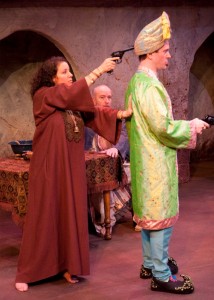
Photo by Jeff Gaines: L to R: Suehyla El-Attar, Tom Thon, Joe Knezevich
In some ways I feel sorry for Ismail Khalidi, the winner of the 2009 national Kendeda Graduate Playwriting Competition. His play “Tennis in Nablus,” now premiering at the Hertz Theatre, is so well written the young playwright may not be able to top it.
“Tennis in Nablus” recalls the beginning of the conflict between Arabs and Jews when Jewish settlement was just beginning in Palestine. Set in 1939, when Great Britain ruled Palestine and nearly a quarter of the world, the audience glimpses what life was like for the British, the conscripts who hailed from its conquered countries, and the Arabs and Jews in Palestine.
But more so than being a political play, this is a drama about humankind and the way people treat each other. Exploitation, love and hate, with sprinklings of humor, it’s all there.
What is missing, however, is great acting. In general the acting is good but not grab-you-by-the-shirt-collar take notice great. One actor, who I’ve seen a few times on Atlanta stages, is bland. This performer goes through the exterior motions of acting and doing, but the internal piece that connects to the actor’s heart is missing.
Nonetheless, the show, which runs a little more than two hours, flows quickly. There is constant action, and every scene moves the story forward.
“Tennis in Nablus” will probably be one of many great plays by Khalidi, whose play “Truth Serum Blues,” which examines terrorism and patriotism, was produced at Pangea World Theater in Minneapolis. Born in Lebanon and reared in Chicago, Khalidi graduated last year from the MFA program in Dramatic Writing at New York University’s Tisch School for the Arts. He was awarded finalist for Williamstown’s Weissberger Award, the Goldberg Prize in Playwriting, the Quest for Peace Award from the Kennedy Center, and the second-place prize for the Kennedy Center’s Mark Twain Award.
Staged with a smart set that serves as an eloquent adobe fortress, a simple house, and an outdoor tennis court, “Tennis in Nablus” runs at the Hertz Theatre through Feb. 21.

The Oceanaire Seafood Room
In Atlanta, finding restaurants that serve fresh seafood is easy, but finding one that cooks it right is not. Thankfully, the Oceanaire Seafood Room cooks and seasons it to perfection.
With a menu that includes about 10 fresh catches of the day, a surf and turf, plenty of sides and appetizers, and a fantastic wine list by the glass and bottle, a seafood lover can’t go wrong.
There may be a recession, but people keep coming to Oceanaire. By 8 p.m. on a recent Saturday, every table within my sight was seated with diners.
The restaurant’s bright, open dining room is filled with spacious booths and dining tables that leave plenty of room between them so you and your company can eat and talk in private. Jazz from the 1940s coos softly in the background, and the level of noise from the bar and dining room is low, making Oceanaire a comfortable place for business or dining with a date or friends.
Within a moment of my sister, Laurie, and I being seated, our busboy, Saul, brought us water and a dish of pickled herring, carrots, kosher pickles, and black olives, reminding us of South Florida’s famed Ronnie’s and Wolfie’s delicatessens. Following on Saul’s heels was our server, Antonio. After hearing about my tastes in wine, he helped me select a magnificent glass of Sauvignon Blanc called Wairu River.
Within a couple of minutes Antonio brought our amuse bouche—crostini with marinated onions laced with a balsamic reduction. It did nothing for me, but Laurie liked it. I ordered the roasted corn and smoked salmon fritters appetizer. I was expecting a version of a crispy crab cake, but the inside tasted like a salmon spread. Laurie liked it more than I, but we both agreed that neither of us would order it again. While she enjoyed her spinach salad, which featured a tangy vinaigrette with bacon, I ate sourdough bread with yummy, creamy unsalted butter.
We both ordered fish from the selections that had arrived that day. When Laurie ordered the Georgia trout picatta I figured I’d just have a bite. Georgia trout sounds mundane, but this was anything but that. Lightly cooked, the trout lay on a picatta sauce with capers and was so delectable—reminiscent of Dover sole– I ate half of it, and drowned it in the sauce. While I’m generally not a fan of buttery sauces, this was more savory than rich.
My ahi tuna rubbed in fresh ground pepper was cooked perfectly, barely seared on the outside, rare on the inside, and drizzled with an almost imperceptible wasabi cream sauce. I split the dish with my sister. While we both normally favor tuna, we thought the trout was better. Still, they were both so good that even though Oceanaire serves ample portions, I could have eaten both entrées in their entirety.
But not everything was wonderful. Neither Laurie nor I liked the cole slaw. It was finely chopped, and mixed with vinegar and loads of pepper. I am not fond of super sweet coleslaw, but this could have used a sweetener. My thinly sliced French fries were soft on the inside and on the outside. I would have liked them to have cooked for a minute or two longer to get a tad crispy on the outside.
I’m not a big dessert person but tried the sorbet of the day, mango. It had been overly sweetened and could have used a dash of lemon or lime to give it a kick.
The restroom was both nice and disappointing. It featured mouthwash, paper cups, and fluffy cloth hand towels. But even after waiting for a couple of minutes at the sink, ice water poured from the hot water side.
While some improvements need to be made at Oceanaire, the attentive service and fish are impeccable.
The Oceanaire Seafood Room is located in Atlanta on Peachtree Street at the corner of 15th Street.
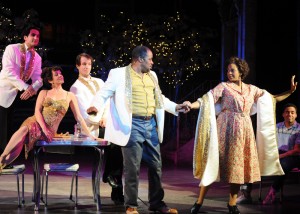
L to R: Jeremy Cohen, Rebecca Blouin, Steve French, Lawrence Clayton, Neda Spears, J.D. Goldblatt, Photo: Greg Mooney
When I heard about the new doo-wop show, “Avenue X,” at the Alliance Theatre, I hoped one thing: Please don’t be an imitation of the doo-wop musical “Jersey Boys,” because it could never compete.
Sadly, it feels like it’s riding the wave of that very same show with borrowed themes from other musicals. But whereas every scene in “Jersey Boys” moves the story forward and the traveling casts are dynamic, the scenes lag in “Avenue X,” and some actors lack passion and credibility.
While the cast is OK, there are a few top-quality performances. Lawrence Clayton (Roscoe) has some great moments, and Neda Spears (Julia) sings a dynamic solo. But when you look at the play as a whole, you wish you didn’t have to.
If you’re wondering what’s the plot and where is the action in the script, I don’t know. To summarize, the year is 1963. A woman, her lover, and her teenage son leave Harlem and become the first black family in an Italian neighborhood in Brooklyn. A little spin off “West Side Story” and, you guessed it, there’s a tussle between the black family and the Italian teenage boys.
Music brings them together. At one point they meet and compete singing five songs in a row, improvising their soul inspired, doo-wop tunes with one strong bass voice from Ubazz (Steve French), whose sound is reminscent of “Bauzer” of Sha Na Na.
Five songs in a row with no action in between them might not be so boring if the songs moved the story forward or if they were outstanding tunes. But they don’t and they aren’t. Then there’s that Mickey Rooney plot: Gee fellas, let’s put on a show. Except in “Avenue X” the teens come together to enter a singing contest.
If the music were great instead of mediocre, it might have made this show enjoyable. As for the story line, you’d think at the end there would be some sort of resolution to this discord between the two groups. Either they would decide to continue to fight each other or they would unite. No thoughts on how to end this story other than killing off a main character? Gee fellas, let’s sing another song!
If you’re a fan of doo-wop, “Avenue X” might be for you. If you’re looking for a play with substance, continual action and an energetic cast, it probably isn’t.
“Avenue X,” with book and lyrics by John Jiler and music by Ray Leslee, runs at the Alliance Theatre through Feb. 7.
Grammy Award-winning bassist Christian McBride will be playing with his band Inside Straight at the Rialto Center for the Arts this Saturday.
McBride, whose musical styles vary as much as the musicians he has played with, has been one of the most popular bass players for the past two decades. Before leading his own bands, McBride played as a sideman or session player with the biggest names in the music industry, including McCoy Tyner, Sting, Willie Nelson and Diana Krall.
While studying at Julliard in 1990, McBride became an in-demand player in clubs around New York. A year later, he left to tour with Roy Hargrove and then landed a position playing for three years with Freddie Hubbard’s band.
McBride has recorded on more than 250 albums with a disparate group of musicians, including Uri Caine with the out-there, soulful and funky band The Philadelphia Experiment.
The video above comes from McBride’s performance earlier this week on “Good Day New York” where his band played a tune from his newest album “Kinda Brown.”
McBride and Inside Straight will perform at the Rialto on Saturday, Jan. 17 at 8 p.m.

Shen Yun
Atlanta has been flooded with Shen Yun posters at shops around town and on billboards. At Perimeter Mall an Asian woman tried to press into my hand a brochure about this New York-based dance company that bills itself as “the world’s premiere [sic] Chinese dance and music company.”
The press release says the program features nearly 20 dances and songs inspired by ancient Chinese culture.
Shen Yun is presented by the New Times Culture and Education Center and the Falun Dafa Association, both affiliates of the Falun Gong empire, which includes the Shen Yun dance company, New Tang Dynasty TV, Sounds of Hope radio network, a performing arts school, the Epoch Times—a newspaper published in 10 languages—and a film production company. Essentially this show is presented by Falun Gong.
Falun Gong was founded in China by Li Hongzhi, who built followers by repackaging ancient Chinese exercises and spiritual concepts—specifically Taoism and Buddhism—with beliefs in extraterrestrials. Chinese authorities outlawed Falun Gong in the late 1990s, and Li now lives in the U.S.
Mary Silver serves as a spokeswoman for Shen Yun and as national deputy editor of the Epoch Times. She said the purpose of the dance performance is to “highlight traditional folklore dances and let people know of traditional Chinese culture.” She said a couple of the dances highlight the persecution and torture that is happening to Falun Gong followers in China but there won’t be any brochures or propaganda spreading Falun Gong.
Will Shen Yun be authentic Chinese dance? Judge for yourself by visiting Atlanta Shen Yun. The show runs at the Cobb Energy Performing Arts Centre this Friday through Sunday, Jan. 15-17.
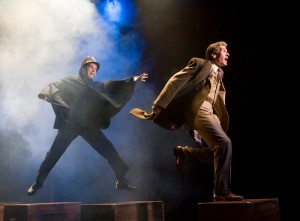 More Laurel and Hardy than the Keystone Cops, “The 39 Steps” is a Vaudevillian slapstick that mixes Alfred Hitchcock movie themes with Mickey Spillane comics and novels.
Adapted from Hitchcock’s 1935 thriller “The 39 Steps” and based on the book by John Buchan, the play takes a lighthearted look at bored Richard Hannay (Ted Deasy) sitting home alone in London when he decides to go to the theater.
Hannay meets Annabella Schmidt (Claire Brownwell) who sits in the theater box across from his. He takes her home, and in her German-Russian accent she reveals she is being chased by assassins who know about the secretive “39 steps.” Before she can disclose anymore about them, she is murdered while sitting on Hannay’s lap.
The spy thriller begins.
Three actors and one actress play a variety of characters who change before your eyes as they spin around and become someone else. Man #1 (Eric Hissom) and Man #2 (Scott Parkinson) play a variety of quirky male and female characters and make the audience squeal with delight at their physical comedy.
While the acting is superb, the physical comedy is outstanding. Thanks to movement director Toby Sedgwick, the characters come off as fine-tuned soldiers whether they are acting as barkers at a Vaudeville show or as passengers who move in unison while traveling on a train or a car.
“The 39 Steps” has won the Olivier Award for Best Comedy, a Drama Desk Award, and two Tony Awards. The play runs at the Cobb Energy Performing Arts Centre through Dec. 6.