

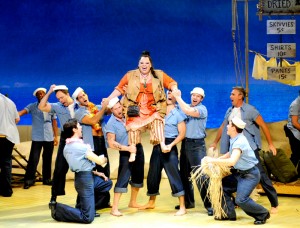
Bloody Mary and the Seabees; Photo: Peter Coombs
It was one of those good cries, the kind you have when everything is just so beautiful, so wonderful, you can’t begin to express it. Your body shakes and you need to blow your nose, but you are jolted up on your feet and have to keep clapping, because you have seen one of those rare near perfect performances that move you to the core of your being.
I almost didn’t even go see “South Pacific.” I saw the professional touring company about 40 years ago and saw the movie so many times by the time I was 13, I cannot even bear to watch it when it comes on TV. Been there. Done that.
Oh, but this show at the Fox is different. It is grand: the singing, the acting, the dancing, the energy, the men, the women, and that lieutenant’s gorgeous bare chest that made me want to run up on stage, knock his love interest aside, and say, “I’ll finish this scene for you.”
And the scenery. I normally could not care less about scenery. Just give me great actors and a good script, and that’s all I need. But this scenery. This is different. It is sublime: beautiful blue seascapes with light blue skies, mountains, sand hills, and gray and black nights. The sets change seamlessly in moments. Actors carry pieces with them and transform a set from a beach to an expansive Air Force office within seconds.
The costumes? They too are perfect, creative and time appropriate. And then there’s that one aqua dress that is so simple and elegant. I want that dress.
“South Pacific” is a beautiful tale of men and women from opposite sides of the ocean who fall in love on a South Pacific island during World War II. Nellie (Carmen Cusack), a Navy nurse from “the sticks” in Little Rock, Ark., falls in love with widower Emile de Becque (Rod Gilfry), a wealthy, debonair older Frenchman. But when she realizes the two children at his home belong to him rather than to his servant, she is disgraced that she would inherit his dark-skinned children from his deceased first wife, a dark-skinned Polynesian, and breaks off the relationship. Similarly, Lieutenant Joseph Cable (Anderson Davis) falls for Polynesian beauty Liat (Sumie Maeda), yet shies away from marrying her because people back in his hometown of Philadelphia would not approve of a native dark-skinned woman.
This Lincoln Center Theater touring production has been updated since “South Pacific” originally played on Broadway in 1949, where it won 10 Tony Awards. The dialogue and action are a little more risqué, and the song “My Girl Back Home,” first heard in the 1958 movie, has been added. The show is directed by Bartlett Sher, who directed the 2008 Broadway revival, which won eight Tonys.
All those family trips from Atlanta to Florida and back, with the “South Pacific” 8-track blaring “Bloody Mary” and “Happy Talk,” and I thought I had had enough of “South Pacific.” It’s been three days since I saw this latest production. I cannot get it out of my mind and cannot stop singing the songs. I don’t want to.
“South Pacific” plays at the Fox Theatre through Sunday, April 11.
You gotta admit that anyone who has the courage to tackle two No. 1 pop songs on the Billboard charts, one by The Beatles and one by the Partridge Family, has got to be either lame or way cool.
Steve Baskin is one fearless rocker who plays mostly original tunes, yet he pulls off playing tunes by The Partridge Family and The Beatles with aplomb and originality. While he rocks “I Think I Love You,” he flips The Beatles’ celebratory “A Hard Days Night” upside down. When Baskin plays it, he takes you floating down a slow river of hardships that only love can heal. Although the tune barely resembles the original, his arrangement sounds just as valid and authentic.
Baskin, a recording artist influenced by music from the ‘60s and ‘70s, R&B and country, will be playing mainly original tunes with his three-piece band at the Red Light Café Friday, April 9.
If you go, be prepared to sing along and shove your table out of the way and dance. Baskin’s country tune “Float on Down” rocks so much it could catapult you into a Texas Two-step or an Irish stepdance. “Catch Me If You Can,” a catchy pop tune released last year on his CD “Naked,” is so infectious it is getting air-play around the country. This summer it was one of the Top 10 most added songs to playlists, according to FMQB, a radio industry organization that tracks tunes.
Baskin, who hid himself in the business world for the past 20 years, began playing music as a kid. By 17, he was playing on the professional circuit as a sideman with The Shirelles, Archie Bell & the Drells, and Samuel David Moore (of Sam and Dave). More recently he has played with Cindy Wilson of the B-52s.
Baskin will be playing at the Red Light Café Friday, April 9 at 9:30 p.m. The pop group Phillip Hanson & Vancouver open at 7:30 p.m., and R&B singer Jess Goodwynn takes the stage at 8:30 p.m.
Mike Daisey is like the big, fat funny guy you knew as a kid who told stories in full animation so you’d burst out laughing no matter what he said. It wasn’t just that his stories were funny; rather, it was that clown-like way he had of acting everything out that made them funny.
The famed monologuist, who has been a guest on “The Late Show with David Letterman” and been called a “master storyteller” by the New York Times, is performing “The Last Cargo Cult” on the Hertz Stage at the Alliance Theatre through April 11 and a one-night performance of “How Theater Failed America” on April 5.
In “The Last Cargo Cult,” Daisey’s rubber face and voice transform him from moment to moment. For a second he seems to be like Julia Child; another moment, he’s like a haughty American; and a split second later, the corpulent blond has become a trim tribal leader of a remote island in the South Pacific.
Mixing rhetoric, philosophy and humor, Daisey follows in the footsteps of the late king monologuist Spalding Gray, who, like Daisey, sat at a large wooden table with a glass of water and his notes laid out in front of him. But whereas Gray mainly told stories in a serious, almost sedated manner, Daisey bursts forth energy like a rocket.
Daisey is nearly perfect. However, his two-hour monologue feels long and would probably play better if he tightened it. That aside, he is still one of the most phenomenal sensations on the stage today.
Mike Daisey performs “The Last Cargo Cult” on the Hertz Stage at the Alliance Theatre through April 11.
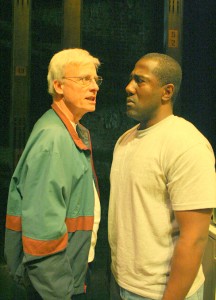
Peter Thomasson as White, E. Roger Mitchell as Black; Photo: Cristopher P. Kettrey
Cormac McCarthy’s play “The Sunset Limited” is now at Theatrical Outfit. I haven’t seen it yet, but it was first produced by one of my favorite theaters, the Steppenwolf Theatre in Chicago, in 2006 and later in the year moved to New York City. McCarthy also wrote “All the Pretty Horses” and “The Crossing.”
I am not familiar with the work of the two actors starring in the show, but I am a big fan of actor Jessica Phelps West, who is directing the production.
West answered some questions about this two-character play via e-mail.
Plays with two characters sitting around talking are often really difficult to come alive on stage. As a director, how do you ensure that a play with two characters and minimal action is something that is riveting to watch?
Well, actually, the playwright has done that for me. His words literally fly off the page into our minds and hearts. McCarthy’s words are active and thus “action” is not missed or even desired. I direct most plays as if they were a piece of music, and my focus is very kinetic, paying close attention to the physical movement of the actors as it correlates to the movement of the script and the relationships of the characters. In this case, the smallest of movements by the actors can speak volumes, and there is great power in stillness as well.
How do you make sure that these characters bring an element of surprise to their roles?
The actors are in command of the energy they contain and expend on the stage, heightening tension by containing their energy, and expending energy by exploding it at the appropriate moment.
What is it about this play that compelled you to direct it and Theatrical Outfit to produce it?
I am most attracted to plays that are concerned with issues of faith and faiths of every kind. They seem to be the most relevant in these times and have the capability to speak to us as human beings on so many levels. McCarthy’s play evokes such strong passions of the mind and spirit for the reader and viewer as well as the characters, and the story is told with such incredible power in its simplicity.
What makes E. Roger Mitchell and Peter Thomasson the right actors for this play?
One of the major themes in the play is the opposing views of a given idea and belief system. McCarthy presents contrast in all aspects of the characters, especially in their polemic views. In casting, I looked for actors that would help to support this theme by their striking physical contrast. Peter is very analytical when he approaches a role, and Roger is very organic. Both approaches are perfect for their characters as Peter is playing the professor, who has arrived at his views of the world with great forethought, almost systematically. Roger plays a simple man of God who is far more instinctual. Normally their opposing approaches could be a challenge to a director in scene work, but I have found it quite helpful in exploring the play. They are both very adept at comedy as well, which helps us bring out the humor in the play.
What should Atlanta audiences expect to see in this production?
I think the ideas presented are universal and very personal at the same time. I hope the audience is moved by a theatrical experience that will stay with them long after the performance is over. I hope, too, that we will all discover something about ourselves, specifically what sustains us and how to become aware of the traps we set for ourselves.
“Sunset Limited” runs through April 11 at Theatrical Outfit.
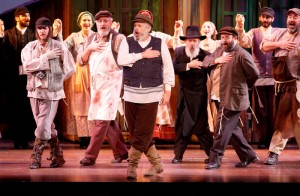
Harvey Fierstein and Company--Photo Credit Joan Marcus
Harvey Fierstein as Tevye? Could the same man known for penning “La Cage aux Folles” and playing a drag queen in his Tony Award-winning play “Torch Song Trilogy” play Tevye in “Fiddler on the Roof”?
Actually, yes. Sometimes, he goes a little overboard with his mugging, and he doesn’t always live in the moment, but he is a believable and funny Tevye.
So, it’s not Fierstein’s fault that there is something not quite right with this “Fiddler on the Roof,” now playing at Cobb Energy Performing Arts Centre.
The play tells the tale of Jewish life in Tzarist Russia, but this cast doesn’t seem to live the tale. It never quite comes to life. The acting and singing are very good, especially that of Chava (Deborah Grausman), whose passion rips at the heart. However, the show lacks drama and electricity.
For example, in what should have been the most dramatic scene in the play in which the Cossacks come to ransack the town of Anatevka, neither the audience nor the actors seemed to be scared. The Cossacks threatened and battered the town, but that scene works a lot better when they ransack and plunder the village. When done right, that scene can put the fear of death into anyone watching it.
Based on a book by famed Yiddish writer Shalom Aleichem, “Fiddler on the Roof” won nine Tony Awards when it opened in 1964. It was one of the longest running shows on Broadway and was revived in 2004. Fierstein starred in the revival after Alfred Molina left.
So, should you see the show at the Cobb Energy Center? To alter a line from the song “Matchmaker:” It’s a nice show, a good show, true? True. But if you want to see a great version of this show, you’ll have to see the movie or a different live production.
“Fiddler on the Roof” plays at the Cobb Energy Performing Arts Centre through Sunday, March 21.
For all you rock and rollers who can’t imagine going to the theater and seeing a play, much less a musical, the Broadway touring company of “Spring Awakening” now at the Fox Theatre may change your mind.
Winner of eight Tony Awards in 2007, “Spring Awakening” is a coming-of-age story that looks into the lives of teenagers in Germany in 1891. It’s a time when girls and boys go to school separately, sex is a forbidden topic, and corporal punishment in school and at home is the norm. Although the story takes place more than 100 years ago, the teenagers’ rebellion against society and struggle for independence and sexual expression could match that of any generation since.
The musical version, by Steven Sater, is based on the original play written in Germany in 1891 by Frank Wedekind. His play was scheduled to run in New York City in 1917, but it was deemed pornographic by the New York City Commissioner of Licenses and closed after one performance.
Not exactly obscene by today’s standards, the play presents some explicit sex scenes. Hanschen (Andy Mientus) sits on stage with his legs spread far apart and masturbates himself underneath his nightgown, Melchior (Jake Epstein) and Wendla (Christy Altomare) simulate making love on stage, and Hanschen seduces his male friend Ernst (Ben Fankhauser).
As much as the show focuses on the sexuality of adolescents, it also highlights their pains from living with and being taught by elders who disrespect and abuse them. Martha’s father sexually molests her and her mother ignores it, a schoolmaster whips Melchior with a long stick, and Herr Stiefel (John Wajda) repeatedly slaps his son Moritz (Taylor Trensch) in the face.
What makes this play work is that all the characters and their stories come across as authentic. Their life situations are the same ones we hear and read about today. Their failures and quest for self expression remind us to question the status quo and decide for ourselves what is right for us.
Yes, there are F-bombs and sex, but none of it is gratuitous.
The music, by Duncan Sheik, mixes styles similar to ballads by Andrew Lloyd Weber, indie and art-rock, and punk from the late 1970s. The costumes (by Susan Hilferty) are styles from 100 years ago, but the mixture of hairstyles — traditional cuts, Mohawks, spikes and high-rise towers (think of the ’70s band Split Enz) — remind us that these youngsters could hail from any generation, especially our own. Bill T. Jones makes the dancing seem as natural as the scenes, the singing and the story.
“Spring Awakening” runs at the Fox Theatre through March 14.
Atlanta actor Brad Sherrill has been performing his one-man show “The Gospel of John” for 10 years. With 600 performances in 40 states, as well as in England, Ireland and Canada, Sherrill has created an acting career that keeps him busy eight months of the year and allows him time to do other acting work.
“The Gospel of John” will be playing in repertory with his new one-man show “Prophets” at Georgia Shakespeare March 24-28.
One of Atlanta’s finest actors, Brad brings a character and a story to life. I spoke with him on the telephone.
You’re doing two shows based on the Bible. Were you always very religious?
I grew up in a church that had a strong drama ministry. I acted at the church as I was growing up in Chamblee and acted in plays throughout my 20s and 30s. I never went to New York or L.A. cause I found steady work in Atlanta. In my late 30s I got burned out going from play to play, some that I didn’t like. One day I started memorizing the prologue to John, my favorite gospel. I had no acting plans when I started memorizing it. It’s almost 20,000 words and took me four and a half months to learn. I was led to the material in a devotional way. As I learned sections I invited people over to my house to perform it. My church said share it with us. The response was positive, and that’s when I went to Theatre in the Square, and it turned into eight well-attended weeks. Other church theater runs followed.
Had you been thinking about doing a one-man show?
I never saw myself doing a one-person performance. The interaction between me and another person is what thrills me. In these shows the audience is the acting partner. Those individuals are the ones you’re working with.
How did you decide on doing Prophet?
These are texts that I was interested in that the three major faiths share. The show is taken from the books of Isaiah and Jeremiah. It’s multimedia with contemporary images that put stories into modern times. It’s ninety nine minutes with no intermission. Gospel is two and a half hours with an intermission.
Where are you performing your shows?
I’ve played to diverse audiences across the country, in small towns with one traffic light and in big cities, mostly in churches but in theaters too. The church books the show for a fee and it charges tickets or gives it free to the community. I’ve performed in a thousand-year old cathedral in England and in church basements and cafeterias. If the story is good, it can be told around a campfire or on a little set.
What kind of advice do you have for aspiring actors and young actors today?
Actors are in a submissive position. They’re dependent on someone hiring them. I’d tell them to create your own work. Don’t wait around for the right play. Write a show for yourself. You have to have a story to tell or express. That’s where the creative urge arises. What do you want to say? With these biblical sources, I found my voice. I’m interested in the questions they ask. How are we supposed to live in this world? These ancient texts answer that question.
Singer-songwriter Craig Taubman and Cantor Alberto Mizrahi perfom “To Life: A Musical Tribute to the Life and Spirit of Dr. Sam Schatten z’l” on Sunday at AA Synagogue in Atlanta.
Taubman has performed in venues across the country, including three performances at the White House. Chita Rivera and Jennifer Holliday have each recorded Taubman’s songs, and he was featured, along with the Grammy Award-winning Klezmatics and with Emmy Award-winning actress Mare Winningham, in the 2008 PBS special “Lights! Celebrate Hanukkah Live in Concert.”
Taubman, whose music features flavors of Israeli and American folk-rock, is based in Los Angeles. He has composed and directed music for Fox and HBO, and his music has been featured in three films: “Andre,” “Pinocchio,” and “Recycle Rex.” The singer-songwriter launched his career performing on the Disney Channel and at Disneyland.
Alberto Mizrahi, a renowned tenor who is cantor of the historic Anshe Emet Synagogue in Chicago, was featured on the 2003 PBS special “Cantors: A Faith in Song” as well as in the aforementioned PBS Hanukkah special. In addition to performing at the White House, he has performed with Dave Brubeck, the Chicago Symphony Orchestra and the New York Philharmonic.
The concert will also feature performances by The Epstein School Choir and the Atlanta Jewish Male Choir.
The tribute will be held at Ahavath Achim Synaogue Sunday, March 7 at 7 p.m.
Catch Joe Gransden’s 16-piece Big Band tonight with guest singer Melanie Massell, daughter of former Atlanta Mayor Sam Massell, at Cafe 290.
Massell has been singing since she was a child and repeatedly has been a featured performer at the Atlanta Jazz Festival. She was nominated as “Outstanding Jazz Artist” at the Coca-Cola Music Awards and appeared at Atlanta Symphony Hall with the Atlanta Concert Band.
In addition to performing on “Star Search” in the ’80s, Massell has appeared in bit parts on TV and film and as a singing talent on radio commercials.
Gransden’s big band, which plays the first and third Mondays at Cafe 290, features a rotating list of the finest musicians in and around Atlanta, as well as a new guest each week. Before starting his own band, Gransden played as a sideman with the big bands of Tommy Dorsey and Glenn Miller and subbed in for Toshiko Akiyo’s band. He has also played sideman gigs with Barry White, The Moody Blues, The Temptations and Aretha Franklin. His big band repeatedly packs the house at Cafe 290—yes, even on a Monday—so call ahead and reserve tickets. Show times are 8:30 and 10 p.m.